
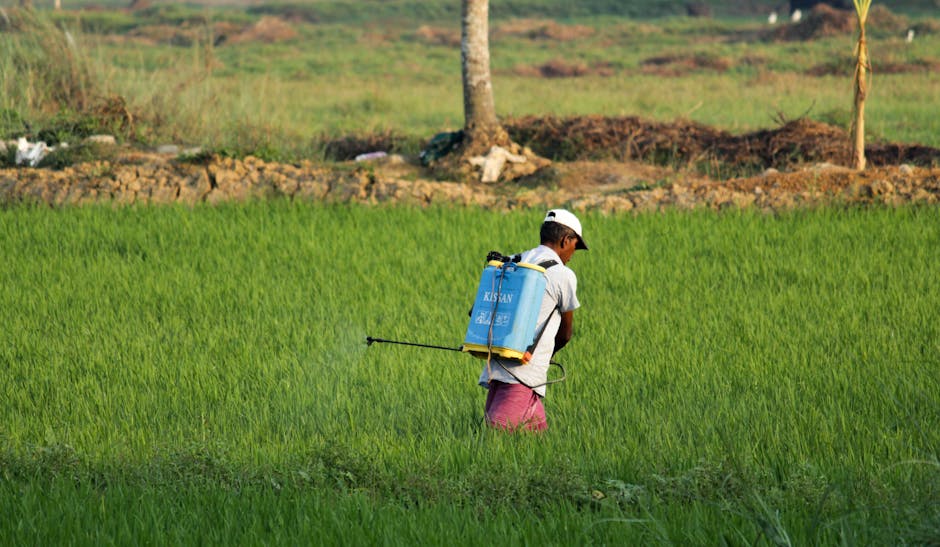
A safe voice service must stop when a farmer’s question goes beyond reviewed guidance, especially when pesticide dosage, re-entry, or pre-harvest intervals are uncertain. In that moment, the right response is a clear Asante Twi explanation and a handoff to a named extension officer, never a plausible-sounding guess.
Consider this illustrative scene. At a cocoa society meeting near Kumasi, Kojo, a young farmer with mud drying around the cuffs of his trousers, holds a phone close to his mouth. The room has been restless. Then he records the question everyone else has been circling around: after spraying the chemical in his shed, when can his workers safely return to the farm?
The conversation stops.
The answer that cannot be guessed
Kojo needs the answer before morning. Two workers are due to enter the field, and rain could narrow the window for the work he has planned. If he sends them in too early, they may face chemical exposure. If he keeps them out without reliable guidance, the farm work stalls.
Several people in the room have an answer. One remembers what a dealer told him. Another recalls waiting until the smell faded. A third says the label should settle it, though nobody has the container at the meeting.
Each response sounds possible. None has been verified for the specific product, dosage, or conditions in Kojo’s question.
AgriVoice is designed for this boundary. A farmer speaks in Asante Twi. The system transcribes the question and selects from content blocks that people have already reviewed. It does not compose agronomy advice from whatever wording appears likely.
For pesticide questions, the boundary is strict. If dosage, re-entry, or pre-harvest guidance has not been cleared by a Ghanaian agronomist, the relevant block stays withheld. The farmer receives an escalation instead of an instruction.
That distinction matters because fluent speech can make uncertain advice sound authoritative. A confident voice does not make an unverified answer safe. The risk is explored further in The Half-Filled Spray Tank AgriVoice Must Refuse to Complete.
A refusal should still move the farmer forward
Silence would leave Kojo with the same dangerous choice. A vague warning to “ask an expert” would shift the burden back onto him without identifying who will answer or when.
A useful refusal needs three parts. It should say that the available guidance does not safely answer this specific question. It should tell Kojo not to act on an unverified interval. Then it should send the question to a named extension officer who owns the follow-up.
In the scene, the phone does exactly that. It does not name a waiting period. It tells Kojo in spoken Asante Twi that the product-specific interval needs human confirmation and that his question has been passed on.
The room remains quiet for another beat. The work may still be delayed. The system has not removed the uncertainty, but it has stopped uncertain advice from becoming an instruction.
This is why escalation cannot be treated as a failure hidden in the margins. During the planned AgriVoice pilot, every escalation needs an accountable person, and the target median response time is under one working day. An unresolved queue would fail the operating test even if the software routed every question correctly. Why human escalation makes AgriVoice safer explains that responsibility in more detail.
Reviewed Twi begins before the voice speaks
The safety boundary depends on the material behind the response. English cocoa guidance cannot simply be passed through machine translation and read aloud. In one live translation check, “kokoo,” meaning cocoa, returned as “chicken.” The sentence could still sound fluent while directing the conversation away from the farmer’s actual problem.
AgriVoice therefore needs spoken Asante Twi reviewed by a farming-aware translator. The translator must preserve the agronomic meaning, use the terms farmers actually say, and flag English source text that appears wrong rather than quietly repairing it.
Chemical content needs another review. A Ghanaian agronomist must confirm the dosage, re-entry interval, and pre-harvest interval before that guidance can reach a farmer. Until then, withholding the block is the intended safety behavior.
The voice itself has limits too. Neuralis has an existing Asante Twi voice that can support the pilot, but testing found that it sounds formal and missed the project’s intelligibility acceptance gate. Farmer comprehension must therefore be measured in the field. If the voice routinely blocks understanding, the workflow needs redesign regardless of how well the selection logic performs.
The meeting ends with a safer next step
Back in the illustrative meeting, Kojo lowers the phone. Nobody writes a guessed interval beside his name. The society’s next action is concrete: keep workers out of the treated field until the designated extension officer confirms the product-specific guidance.
That outcome may feel less impressive than an instant answer. It is also the only defensible one when the reviewed knowledge ends.
The planned two-week pilot will test whether this workflow holds under real pressure: whether questions are answered or correctly escalated, whether any unsafe pesticide instruction reaches a farmer, whether farmers understand the spoken response, and whether a named person closes the escalation.
Kojo leaves with tomorrow’s work still uncertain, but with one dangerous option removed. No polished voice has turned a guess into a command.
Comments
No comments yet.