
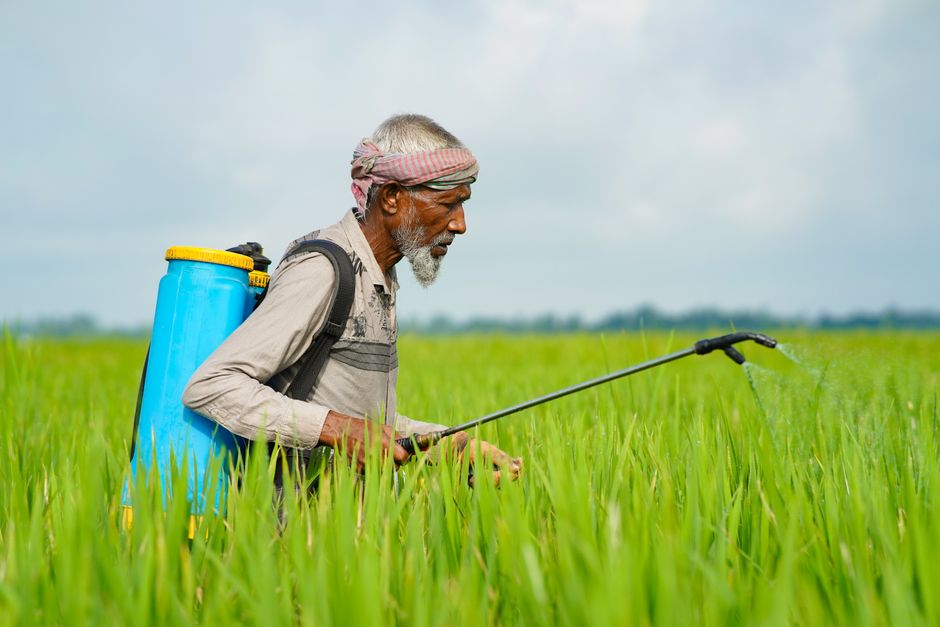
AgriVoice is designed to slow a pesticide decision down when the available guidance has not been reviewed. It should play approved Asante Twi advice or send the question to a named extension officer, instead of producing a confident answer under pressure.
Imagine Kwame, a cocoa farmer and father of three, standing at an input counter outside Kumasi late on a Friday afternoon. He is holding a leaf with spreading brown damage inside a folded plastic bag. Rain may come before he returns to the farm, and the shopkeeper has already placed a bottle beside the till.
“Spray this today,” the shopkeeper says.
The advice sounds decisive. Kwame still does not know the dosage, how long people should stay out of the treated area, or how close the harvest is to the product’s pre-harvest interval. If he leaves without buying, the disease may spread. If he sprays the wrong product or applies it incorrectly, workers could re-enter too soon and the crop could carry an avoidable risk.
For one uncomfortable moment, both bad endings remain possible.
Commercial pressure can make uncertainty sound certain
The shopkeeper may believe the recommendation is right. He may have seen similar leaves before. He also has a product to sell, a queue to move and limited information about Kwame’s farm.
That combination matters. A quick recommendation can collapse several unanswered questions into one command: spray.
Kwame needs more than a product name. He needs guidance that has been reviewed for the actual problem, expressed in language he understands and paired with essential safety conditions. Where those conditions are missing, the responsible answer is a pause.
This is especially important for chemical guidance. A product name without verified dosage, re-entry guidance and a pre-harvest interval leaves the most consequential parts unanswered. Fluent delivery cannot repair missing evidence.
AgriVoice therefore uses a constrained approach. The language model selects from reviewed content blocks. It does not compose agronomy advice from scratch. Chemical blocks remain withheld when an agronomist has not cleared the required safety information.
That refusal is part of the safety design.
What the pause should sound like in Twi
At the counter, Kwame sends a voice question through WhatsApp. He describes the marks on the leaves, names the product on the counter and asks whether he should spray before the rain.
In the planned pilot workflow, speech recognition turns his question into text. The system then chooses among reviewed answer blocks. If the evidence is incomplete or the question falls outside those blocks, it escalates the message to a named extension officer.
The response should not pretend the missing details are known. It should tell Kwame, in reviewed spoken Asante Twi, that the available guidance cannot safely confirm the chemical choice or application instructions. It should preserve any mandatory safety content and explain that a person needs to check.
This sounds modest. It is also the point.
A farmer asking in Twi should not have to accept machine translation as authority. In an earlier test, machine translation changed the Twi word for cocoa into “chicken.” That kind of error can sound smooth while sending the decision in the wrong direction. AgriVoice’s 37 owner-approved blocks still require farming-aware Twi translation and review before farmer exposure.
The same restraint applies to the three chemical blocks that remain held pending review by a Ghanaian agronomist. Until dosage, re-entry and pre-harvest details are resolved, silence or escalation is safer than improvised specificity. When should a system withhold a confident answer to a farmer’s question? examines that boundary more closely.
A human owner makes the check accountable
A generic promise to “ask an expert” leaves Kwame with another queue and no owner. The pilot requires a cocoa-sector partner to name the extension officer who receives escalations.
That name changes the workflow. Someone can see the unresolved question, check the reviewed material, request missing context and respond. The pilot will measure whether escalations have an accountable owner and whether the median response arrives within one working day.
Back at the counter, Kwame tells the shopkeeper he will wait. The bottle stays beside the till.
The extension officer may confirm the product with complete instructions. The officer may recommend a different response after learning more about the symptoms. Either outcome is more useful than an automatic answer that hides uncertainty. The system’s job is to route the question safely and make the unresolved decision visible.
This is also why an escalation queue needs an owner. Technology can identify doubt. An institution must take responsibility for what happens next.
The pilot must prove that restraint works in practice
The two-week pilot is planned for 20 to 50 Asante-Twi-speaking cocoa farmers. Before it begins, every entry gate must be cleared: a partner and extension officer, reviewed Twi content, agronomist approval for chemical guidance, a working WhatsApp conversation, real farmer-speech evaluation, tested consent and deletion behavior, and a full staff safety rehearsal.
The scorecard is equally direct. Any unsafe pesticide instruction reaching a farmer is a stop or redesign signal. The pilot also needs to show that farmers understand the responses, return in the second week and receive useful answers or correct escalations without breaking the rhythm of a conversation.
Kwame’s story ends with a smaller action than a sale. He slips the leaf back into its plastic bag, saves the officer’s reply for the next morning and leaves the bottle unopened.
That pause is the outcome AgriVoice must earn: enough clarity to stop a risky guess, and a named person responsible for helping the farmer decide what comes next.
Comments
No comments yet.