
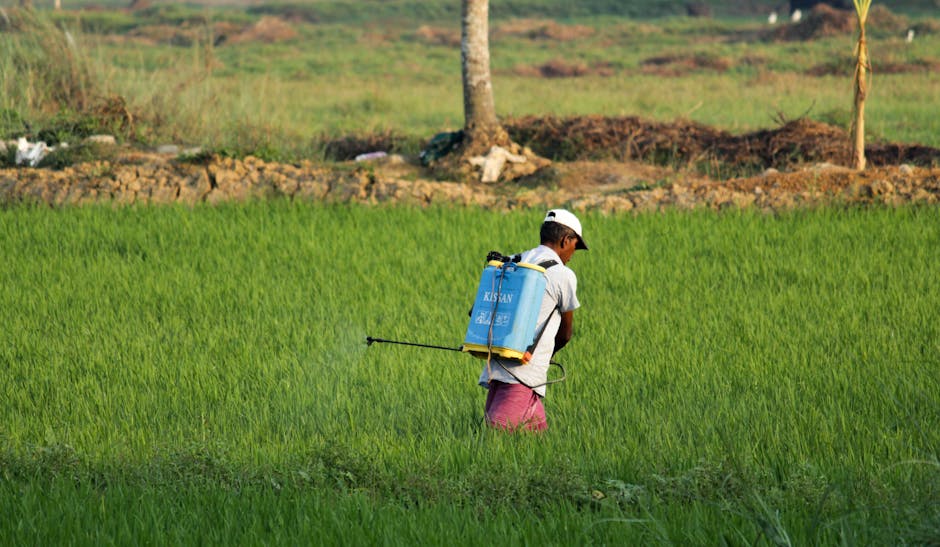
A dosage alone cannot tell a cocoa farmer when a sprayed field is safe to enter again. A safe voice service should give only agronomist-reviewed guidance, include mandatory re-entry and pre-harvest details, and send incomplete or uncertain questions to a named extension officer.
Imagine Kojo at the edge of his cocoa farm near Kumasi, one hand on the sprayer and the other holding a pesticide container. The label gives him a mixing dose. It does not give him an answer he can confidently apply to the next decision: can his sister return tomorrow to clear weeds between the trees?
Rain is threatening, and Kojo wants to spray before it arrives. If he guesses wrong, someone could enter the field too soon. If he waits without help, he may lose the spraying window. The dosage looks precise, but the missing safety interval leaves the decision unresolved.
A precise dosage can still leave dangerous gaps
Chemical guidance involves a chain of decisions. The product must match the crop and problem. The dose must be correct for the formulation and equipment. The person mixing and spraying needs appropriate protective measures. Workers need to know when they may re-enter. Farmers also need the pre-harvest interval, which determines how long they must wait before harvesting treated cocoa.
Removing any link weakens the entire answer.
This matters especially in a voice conversation. A farmer may ask, “How much should I mix?” while assuming the answer also means it is safe to spray now. A useful response must catch that hidden assumption. It should state the reviewed dose only when the exact product and relevant conditions are clear, then include the safety information that changes what happens after spraying.
AgriVoice is being prepared around that constraint. Its language model selects reviewed content blocks rather than writing agronomy advice from scratch. Three chemical blocks remain withheld because dosage, re-entry and pre-harvest details still require clearance from a Ghanaian agronomist. Refusing those questions is the safe behavior while that review remains incomplete.
That same principle appears in the three chemical blocks AgriVoice withheld: fluent speech cannot compensate for missing evidence.
Reviewed content sets the boundary of the answer
A reviewed block should function as a complete decision aid, not a loose paragraph about a pesticide. Before it can reach a farmer, the block needs the exact details an agronomist has approved, including dosage, re-entry interval and pre-harvest interval where applicable.
The spoken Asante Twi also needs review by someone who understands farming vocabulary. Literal translation can alter the meaning of a domain term while still sounding natural. Neuralis has already seen machine translation turn kokoo, cocoa, into “chicken.” In pesticide guidance, that kind of confident substitution could carry real consequences.
The safer workflow keeps the English source fixed, lets a farming-aware translator query anything that sounds wrong, and requires expert approval before the translated advice becomes available. The voice then reads reviewed content. It does not improvise around a gap.
For Kojo, that boundary is simple: if the system has an approved answer for the identified product and situation, he hears the required safety details together. If any essential detail is absent, the system says so plainly.
Human escalation must end with an accountable person
“Ask an expert” sounds responsible, but it leaves the farmer where he started unless someone owns the question.
A working escalation path needs a named extension officer, enough context to understand the request, and a clear operational expectation for responding. The system should preserve the uncertainty instead of converting it into a guess. The farmer should hear that spraying must wait because a required safety detail has not been verified.
Back at the farm boundary, Kojo receives that pause. The answer does not stretch the dosage on the label into permission to proceed. His question is marked for the partner’s extension officer, with the product and missing re-entry detail made clear.
The rain may still arrive. The lost spraying window remains possible for another beat. Yet the alternative, sending his sister into a recently treated field without verified guidance, carries a risk that convenience cannot justify.
This is also why escalation must be tested before a farmer pilot begins. A button, queue or notification proves little by itself. Staff need to run the complete path and confirm that uncertain chemical questions reach the responsible person without an unsafe answer slipping through.
The safe outcome begins before anyone opens the container
When the extension officer supplies verified guidance, Kojo can plan the work around the full instruction. He knows how to mix the product, when people may return and how treatment affects harvest timing. Until then, the sprayer stays closed.
That restraint protects more than one afternoon’s work. Healthier farming households support stronger cocoa supply chains because the people doing the work remain central to every production decision. Safety information should therefore arrive as part of the answer, not as an optional warning after the dose.
Before approving any pesticide response, read it aloud and ask three questions: Does it identify the exact situation? Does it include every required safety interval? If one detail is missing, does a named person receive the escalation?
If the third answer is uncertain, the chemical guidance is not ready for the field.
Comments
No comments yet.