
Greater sector accountability can improve who answers for cocoa policy, but it cannot turn a remote voice service into a pair of eyes on a muddy farm. When a farmer’s question depends on the condition of a tree, the recent weather, or a chemical label, the safe answer may be to stop and send the question to a qualified person.
Consider Kwaku, an illustrative composite farmer in the Ashanti Region. Late one afternoon, he hears a radio discussion about the Ghana Cocoa Board Bill, 2026, which cocoa farmers in parts of the region have welcomed. The promise that institutions could become more accountable stays with him as he walks back to his farm, a cutlass in one hand and mud pulling at his boots.
Then he sees the leaves.
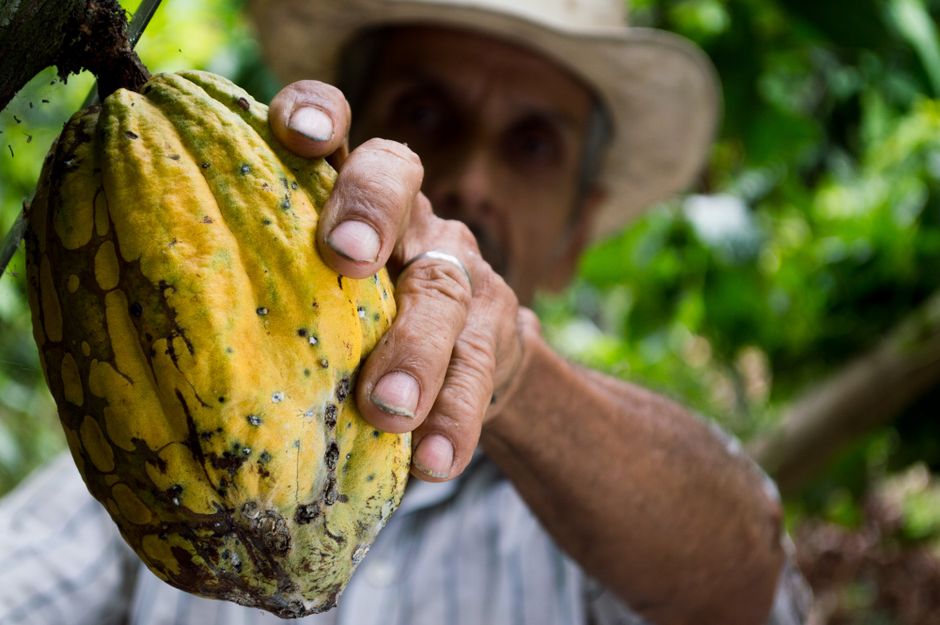
Several cocoa trees near the lower edge of the farm have developed dark patches. The ground is still wet, and pods on two trees look different from the ones farther uphill. Kwaku wants one plain answer in Asante Twi: “What should I spray?”
He needs that answer before buying a product or applying something already stored at home. A confident mistake could damage the crop, expose someone entering the field, or leave him following the wrong interval before harvest.
A policy promise becomes a question with consequences
Accountability sounds broad on the radio. In Kwaku’s field, it becomes specific: Who will answer his question, what evidence will they use, and who takes responsibility when the available information is insufficient?
A voice service can recognize the words “dark patches” and “spray.” It may match the question to reviewed guidance about common cocoa problems. Yet those words do not reveal whether the symptoms come from disease, waterlogged soil, physical damage, or another cause. The service cannot inspect the affected leaves, compare pods across the farm, or read the label on the container Kwaku plans to use.
Guessing would sound helpful for a few seconds. The cost would arrive later.
That is why AgriVoice is being prepared around reviewed content rather than open-ended agronomy generation. The language model selects approved information blocks. It does not write new farming advice. Chemical guidance remains withheld when dosage, re-entry periods, or pre-harvest intervals have not been verified by a Ghanaian agronomist.
This boundary matters more than a smooth conversation. When a system should withhold a confident answer depends on the evidence behind the response and the harm a wrong instruction could cause.
The safest answer may require muddy boots
In the intended pilot workflow, Kwaku records his question in Twi and receives reviewed guidance when the evidence supports it. If the question is ambiguous, outside the approved content, or dependent on farm conditions, the system escalates it to a named extension officer.
For this scene, the response does not name a chemical. It tells Kwaku that the symptoms cannot be identified safely from his description alone and that a person needs to inspect the affected area before recommending treatment.
That leaves the outcome uncertain. Rain may spread the problem. An escalation queue without an accountable owner could sit untouched while Kwaku decides whether to spray anyway.
The turn comes when the assigned officer reviews the recording and arranges to examine the trees. At the farm, the officer can ask where the symptoms began, inspect the lower ground, compare affected and unaffected plants, and check the exact product Kwaku has available. Only then can advice reflect the conditions in front of them.
The voice workflow has done something useful without pretending to know more than it does. It captured the farmer’s question in the language he chose, delivered the reviewed information available, and carried the unresolved part to someone responsible for the next step.
That human handoff needs an owner and a response standard. Otherwise, as the escalation queue problem shows, “ask an expert” can become another dead end.
Accountability must be visible at the last mile
A reform promise earns trust through repeated, observable decisions. For a farmer using voice technology, that means knowing when an answer came from reviewed guidance, when the system lacks enough information, and who receives an escalation.
Neuralis plans to test those decisions in one focused AgriVoice pilot with 20 to 50 Asante-Twi-speaking cocoa farmers over two weeks. Before farmer exposure, the content must be translated and reviewed, the held chemical blocks must be cleared or remain withheld, real farmer speech must be evaluated, WhatsApp must work end to end, and a cocoa-sector partner must name the extension officer responsible for escalations.
The pilot will treat a correct escalation as a successful outcome. It will also stop or redesign around any unsafe pesticide answer. That standard puts the farmer’s safety ahead of an impressive response rate.
Back in the illustrative field, Kwaku has not received a magical diagnosis from his phone. He has avoided spraying on a guess. His recorded question now has a named destination, and the next answer can begin with the leaves in front of the officer, still wet with mud from the lower part of the farm.
Comments
No comments yet.