
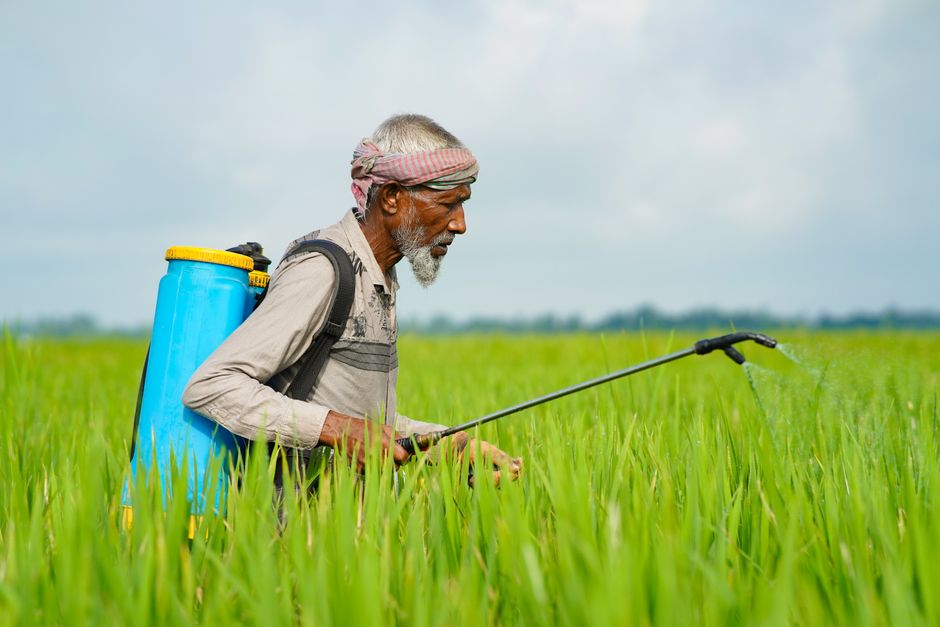
When reviewed pesticide guidance is missing, AgriVoice should withhold the instruction and send the question to a named extension officer. A voice system has no basis to guess a dosage, re-entry interval, or pre-harvest interval when a farmer may act on the answer that morning.
At 6:12 a.m., Kwaku has the sprayer on the ground beside his cocoa plot and a folded cloth over one shoulder. The leaves he noticed yesterday still look wrong in the low light. He has already mixed water. What he needs now is the amount of product to add, and whether he can return to the plot after spraying.
The bad outcome is close enough to touch. Too little treatment could leave the problem to spread. Too much, or a wrong interval, could expose Kwaku or affect the crop he hopes to harvest. A confident voice note with an unreviewed instruction would make that risk feel settled when it is not.
A missing answer has to change the workflow
AgriVoice is being prepared for a small cocoa-farmer pilot with Asante-Twi-speaking farmers. Its safety boundary is simple: the system selects from reviewed answer blocks. It does not write agronomy advice from scratch.
That means absence matters. Three chemical-related blocks remain held because their dosage, re-entry, and pre-harvest details have not been verified by a Ghanaian agronomist. The system should refuse to turn those gaps into spoken instructions.
For Kwaku, the turn comes when his question does not receive a plausible-sounding mixture ratio. Instead, it is marked for human follow-up through the pilot’s escalation path. The answer has changed from “spray this amount” to “this requires review before you act.”
That can feel unsatisfying in the moment. It is still the safer outcome. A farmer facing a field problem needs help that preserves the difference between known guidance and an unverified guess.
Escalation needs an accountable person
“Ask an expert” only works when an actual person owns the next step. Before farmers are exposed to AgriVoice, a cocoa-sector partner must name the extension officer who receives escalations.
This is the operational detail that makes withholding useful rather than evasive. The officer has a route into the conversation, a responsibility to respond, and the context to clarify what the farmer is seeing before advising on a chemical product.
Kwaku puts the sprayer aside instead of mixing the product. Later, he can describe the symptoms again, answer any follow-up questions, and receive guidance from someone responsible for the decision. The morning has not become easy, but the farm has not been put at greater risk by a made-up answer.
That model also gives the pilot something concrete to measure: whether escalations reach the named owner and whether the median response stays below one working day. A queue with no accountable person simply moves uncertainty out of sight.
Reviewed content is part of the safety system
The work behind a safe spoken answer happens before the voice note is sent. AgriVoice needs farming-aware Asante Twi translations for its approved content blocks, because machine translation has already shown how easily a domain noun can be silently changed. In cocoa advice, a fluent sentence can still be dangerously wrong.
It also needs expert review for the chemical blocks. Product names alone do not make an instruction safe. Farmers need the relevant dosage and intervals for the specific situation, and those details require agronomy review.
This is why the pilot has entry gates rather than a broad public launch. The team must complete reviewed spoken content, test the WhatsApp route, collect real farmer questions for speech-recognition measurement, and run a staff safety rehearsal with a working escalation path. Each gate protects against a different way a plausible response could fail in practice.
The same principle appears in extension work already taking place around cocoa farming. Gold Fields Ghana Foundation’s expanded programme combines production inputs with practical training and extension support through COCOBOD’s Cocoa Health and Extension Division. Inputs alone do not answer every question at the point of use. A safe voice workflow should strengthen access to reviewed guidance and accountable human support.
For another example of why uncertain diagnosis must remain visible, see The Pod Mark a Farmer Shouldn’t Treat on a Guess.
The useful answer may be a pause
A voice assistant earns trust by making its limits clear at the right moment. In agriculture, that moment may arrive before sunrise, with a sprayer ready and a crop problem in front of the farmer.
AgriVoice should answer quickly when a reviewed block fits the question. When it does not, it should escalate clearly, preserve the question for the extension officer, and avoid filling silence with authority it has not earned.
Kwaku’s useful next step is not a guessed ratio spoken in a calm voice. It is a clear handoff, a sprayer left unopened, and a named person who can help decide what belongs in the tank.
Comments
No comments yet.