
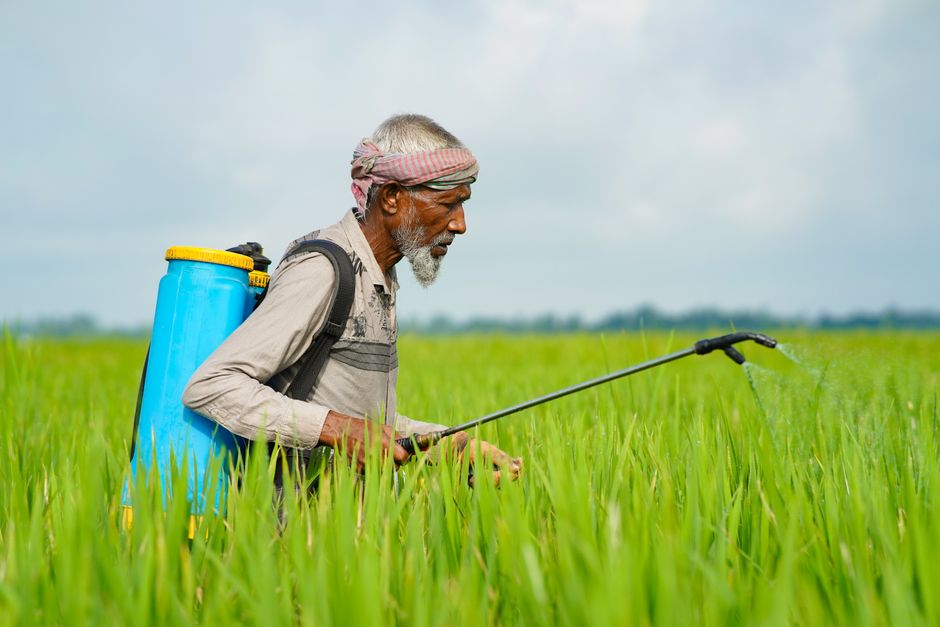
An English text box can end a conversation before a cocoa farmer asks the question that matters. When spelling becomes the price of entry, unresolved spraying decisions return to the farm without reviewed guidance or a clear path to a person.
Consider Kojo, an invented composite of the farmers AgriVoice is being designed to serve. Late one afternoon near Kumasi, he stands beside a knapsack sprayer with a stained pesticide label in one hand and his phone in the other. Rain may arrive soon. He needs to know whether the product is suitable for the marks spreading across several cocoa pods, and whether anyone can safely enter the field after spraying.
The page gives him a blinking cursor and an English text box.
Kojo tries to write “black pod,” deletes it, and starts again. He can describe what he sees in Asante Twi. He can point to the dark patches, explain how quickly they appeared and say which trees are affected. But he cannot confidently spell the English question the system expects.
He closes the page.
The sprayer remains full. The disease may continue spreading if he waits, but spraying the wrong product or using an unverified dose could expose workers and damage the crop. Nothing in the abandoned text box records that decision. No extension officer sees the hesitation. The cursor simply stops blinking.
A language barrier can hide a safety decision
A conventional text interface can mistake writing confidence for subject knowledge. Kojo knows his farm, remembers when the symptoms began and notices details that matter. The interface measures something else: whether he can turn those observations into typed English.
That mismatch creates silent failure. A failed form may look like low interest in an analytics report. On the farm, it can mean that a chemical decision remains unresolved.
Translation alone does not remove the danger. Machine translation can produce fluent wording while changing a domain term. In Neuralis testing, “kokoo,” meaning cocoa, returned as “chicken.” A polished sentence with the wrong crop is worse than a visible misunderstanding because it invites confidence.
The safer path begins with spoken Asante Twi, the language Kojo can use to describe the problem accurately. Speech recognition turns that question into text, but the system still needs strict limits on what happens next.
The answer must come from reviewed content
AgriVoice is being prepared around a constrained workflow. The language model selects from reviewed answer blocks; it does not compose agronomy advice from scratch. If the question does not match approved content, or if the system is uncertain, it should escalate to a named extension officer.
That boundary matters most for pesticides. Three chemical guidance blocks are currently withheld because dosage, re-entry intervals and pre-harvest intervals have not been cleared by a Ghanaian agronomist. The correct response is refusal or human escalation until those details are verified.
This is the same principle explored in What Should Voice AI Do When Pesticide Guidance Has Not Been Verified?: uncertainty must remain visible. A system should never fill a dangerous gap with plausible language.
For Kojo, that means a useful voice response may say that the available guidance cannot confirm the product or dose and that his question needs human review. It may feel less impressive than an instant answer. It protects him from acting on invented certainty.
Voice access still has to prove itself in the field
Replacing a text box with a microphone does not complete the job. The system must understand real farmer speech, including background noise, code-switching and pronunciation that differs from recorded reading samples. The spoken response must also be understandable and acceptable.
Neuralis is preparing a two-week pilot with 20 to 50 Asante-Twi-speaking cocoa farmers, once every entry gate is cleared. Those gates include reviewed Twi content, agronomist approval for held chemical blocks, real WhatsApp messaging, farmer-speech evaluation, tested consent and deletion behaviour, and a working escalation route.
The pilot will measure whether questions are answered or correctly escalated, whether any unsafe pesticide instruction reaches a farmer, whether people understand the voice, and whether they return in the second week. It will also measure response time, escalation handling and cost per completed question.
These checks keep the focus on the decision at the farm. A live demonstration can show that speech moves through a pipeline. Only field evidence can show whether Kojo receives useful guidance before uncertainty pushes him toward a risky choice.
Design for the moment after “I do not know”
Return to Kojo beside the sprayer. In the safer version of the scene, he presses and holds a WhatsApp voice button, describes the marks in Asante Twi and sends the message. The system selects reviewed guidance when it has a safe match. If the product, dosage or diagnosis remains uncertain, the question moves to the extension officer instead of disappearing.
The landing is deliberately modest. Kojo has no fabricated diagnosis and no guessed chemical instruction. He knows the decision is unresolved, knows that a person has received the question, and leaves the sprayer sealed while he waits.
That is what the English text box failed to provide: a way to express the full problem, a visible boundary around uncertainty and a next step when automation must stop.
Comments
No comments yet.