
Climate finance reaches the ground only when a farmer can turn support into a safe, useful decision. Funding totals and delivery receipts miss the final test: did the farmer understand the advice well enough to decide what to do next?
In April 1970, the Apollo 13 crew faced rising carbon dioxide inside the spacecraft. The command module’s square scrubber cartridges would not fit the lunar module’s round openings. Engineers in Houston had to design a workaround using materials already available aboard the spacecraft, then explain the assembly clearly enough for astronauts Jack Swigert, Fred Haise and Jim Lovell to reproduce it far from Earth.
The instructions could not be broadly correct. They had to work in the place where the problem existed, with the tools and time the crew actually had. Jim Lovell and Jeffrey Kluger document the episode in Lost Moon, their account of the mission and its uncertain return.
That is the missing layer in much climate-finance reporting. A programme may fund training, distribute inputs or send information into a farming community. The result still depends on what happens during the walk back to the plot.
The decision begins with a voice note
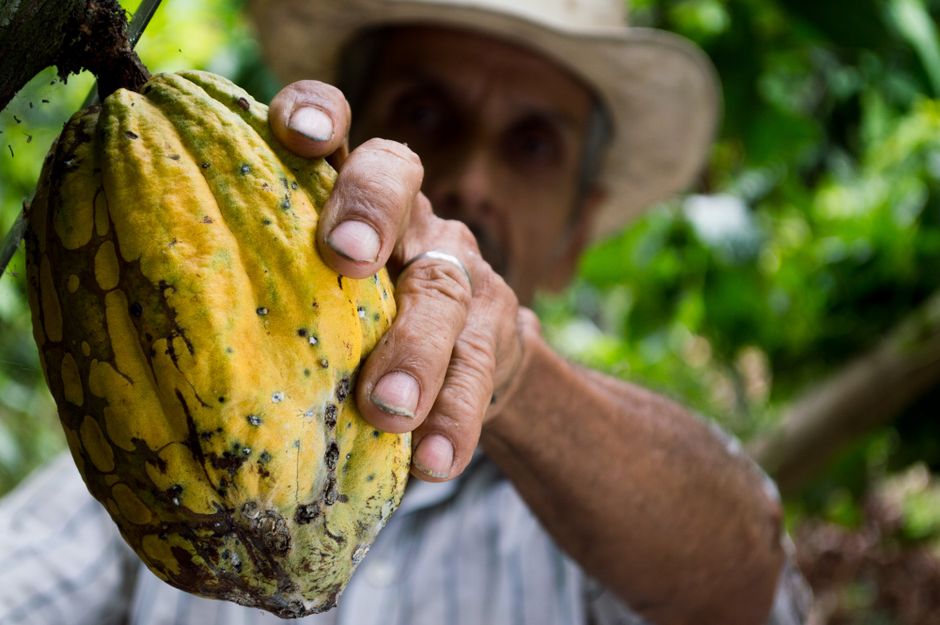
Imagine an Asante-Twi-speaking cocoa farmer standing near the edge of a plot in Ghana. The farmer has noticed something on the cocoa pods or leaves and wants to know what to do. Typing a detailed question may be awkward, so the farmer records a Twi voice note.
AgriVoice’s proposed workflow turns that recording into text, selects from agronomy content reviewed in advance, speaks the answer in Asante Twi and escalates uncertain questions to a named extension officer. The language model selects approved content blocks. It does not compose fresh agronomic advice.
That boundary matters. Machine translation has already shown how quietly a system can fail: in one test, the Twi word for cocoa came back as “chicken.” The sentence could sound fluent while pointing at the wrong crop.
Chemical questions require even tighter limits. Three AgriVoice content blocks remain held because dosage, re-entry and pre-harvest guidance still needs clearance from a Ghanaian agronomist. Until that review is complete, refusal and human escalation are the safe outcomes. Kofi’s pesticide question and the six gates protecting his family shows why every gate matters.
The reply faces a harder test on the path back
Now follow the hypothetical farmer after the audio reply arrives.
Can the farmer hear every important word? Does the Asante Twi sound familiar enough to follow? If the answer names a symptom, does that symptom match what is visible in the plot? If the system says to wait for a person, is there an accountable extension officer who will respond?
A delivered message proves very little about those questions.
Neuralis plans to measure comprehension directly during a two-week pilot with 20 to 50 farmers. The target is for at least 80 percent to report understanding the response. The pilot will also track whether at least 70 percent of questions are answered or correctly escalated, whether farmers return in the second week and whether any unsafe pesticide instruction reaches them. One unsafe pesticide answer triggers a stop or redesign decision.
These measures expose the outcome conventional reporting often compresses into “beneficiaries reached.” Reach can mean a phone received an audio file. Useful reach means the farmer understood the reply, trusted its limits and could choose a safe next action.
The distinction grows sharper with voice technology. AgriVoice’s existing Asante Twi voice sounds formal because it learned from scripture recordings, and a native speaker scored it at 55 percent on first hearing. More model training did not resolve the gap. Field comprehension will decide whether the voice is acceptable for this narrow pilot or whether a conversational recording becomes necessary.
Count completed decisions, not transmitted messages
Climate-finance programmes need a measurement chain that survives contact with the plot.
Start with the farmer’s real question, including code-switching, background noise and local farming terms. Record whether speech recognition captured it correctly. Check whether the system selected approved advice or escalated uncertainty. Ask whether the farmer understood the spoken response. Then follow the decision: did the farmer inspect another plant, wait for an extension officer, avoid an unverified chemical instruction or take some other appropriate step?
Cost belongs in the same chain. Neuralis plans to measure cost per completed question by component, including speech recognition, language processing, WhatsApp, hosting and human escalation. Cost per message can look efficient while unresolved questions accumulate elsewhere.
The Houston engineers working on Apollo 13 could not stop at sending instructions. The crew had to assemble a functioning adapter from the materials aboard the spacecraft. Climate information deserves the same last-mile discipline, even when the stakes and setting are different.
For AgriVoice, the decisive evidence will come from the farmer who listens, walks back to the cocoa plot and determines whether the reply makes sense there. That decision is the unit worth counting.
Comments
No comments yet.