
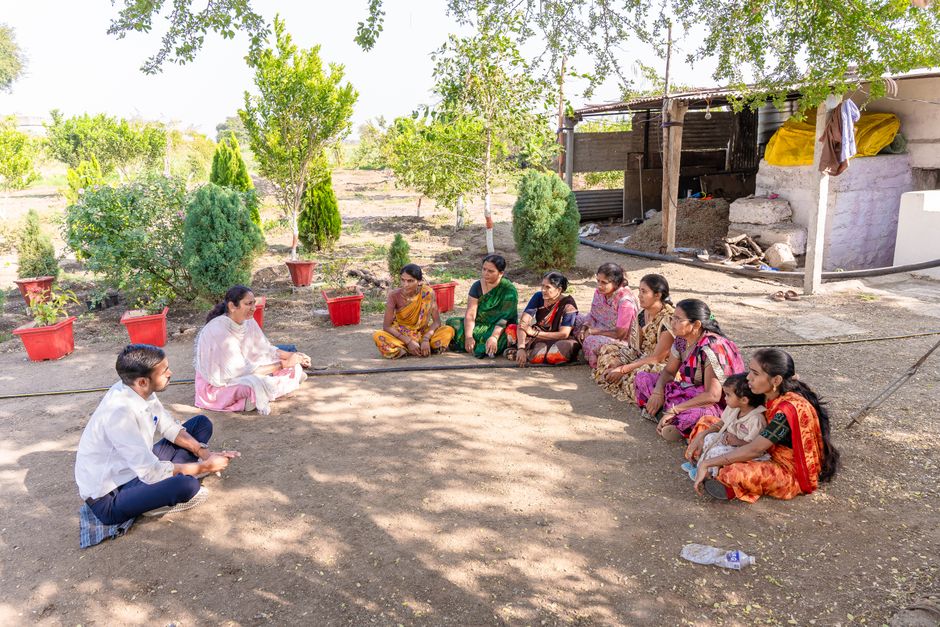
A policy message sticks when a farmer can repeat what changes, who qualifies, what evidence is required, and where uncertainty goes for clarification. A meeting can deliver every official talking point and still fail if those answers disappear before the farmer reaches home.
Consider Kojo, an illustrative composite: a young cocoa farmer standing beneath a corrugated roof after an afternoon meeting near Kumasi. He is holding a folded page of notes while three older farmers wait for him to explain a new policy in Asante Twi.
Kojo remembers the broad promise. He remembers a funding announcement and a reference to the coming purchasing season. Then one elder asks the question that matters: “Does this include a farmer with six sacks, or only registered groups?”
Kojo looks at his notes. The page carries headings, names and figures, but no answer he trusts.
The elders plan to make a decision before morning. If Kojo guesses, one of them could commit money, delay a sale or travel to an office without the required evidence. Nobody in the group can tell whether the policy includes them.
The message that survives the meeting
Institutional communication often succeeds at transmission and fails at recall. A speaker presents the policy. Slides appear. Questions come from the front rows. Attendees leave with fragments.
Those fragments change as they travel.
A funding arrangement becomes “money is ready.” An eligibility condition becomes “every farmer can apply.” A policy still awaiting clarification becomes a promise with a date attached. Each retelling sounds slightly more certain than the one before it.
The recent petition from the Young Cocoa Farmers Association to President John Dramani Mahama shows why clarity matters ahead of the 2026/2027 cocoa purchasing season. The association is seeking urgent clarification of key policies and funding arrangements. That need does not end when an institution publishes an explanation. The explanation must survive the trip from a policy meeting to a farm conversation.
For Kojo, the memorable parts were the parts closest to his daily work. Who can take part? What should a farmer do next? What happens to cocoa already prepared for sale? The institutional background faded because it did not resolve the decision in front of him.
Four details farmers need to repeat accurately
A useful policy explanation gives a farmer four anchors.
First, it names the change in one sentence. “This policy changes how eligible farmers apply for support” gives the listener something firm to carry. A long account of how the policy was developed can follow later.
Second, it defines eligibility with examples and boundaries. A farmer should be able to compare the policy with a real situation: an individual farmer, a registered group, a tenant farmer or someone whose records are incomplete. When a category remains unconfirmed, the message should say so plainly.
Third, it identifies the next action and the evidence required. “Wait for further guidance” leaves room for rumours. “Keep these records and confirm with this accountable office before paying anyone” gives the farmer a safe next step.
Fourth, it preserves uncertainty. This is the hardest part. People naturally fill gaps, especially when money or a deadline is involved. A responsible communication system needs a visible route from “I do not know” to a named person who can confirm the answer.
That same principle shapes the cocoa policy answer AI must not write. A fluent answer can still expose a farmer to loss when the source material does not cover the exact question.
Voice can expose the comprehension gap
A written notice may look complete while leaving the practical questions untouched. Voice creates a tougher test: can a farmer ask in the language and phrasing used at home, then receive an answer that is understandable and bounded by reviewed guidance?
AgriVoice is being prepared to test that question with Asante-Twi-speaking cocoa farmers. Its reasoning layer selects reviewed content blocks rather than composing agronomy or policy advice from scratch. If the reviewed material does not support an answer, the workflow should escalate the question to a person.
That boundary matters in Kojo’s scene. AgriVoice should never invent an eligibility rule to relieve the pressure around the table. A safe interaction would identify the gap, preserve Kojo’s exact question and route it to an accountable extension officer or partner representative.
The same standard applies when a farmer’s wording only partly matches available guidance. A half-match should trigger caution, because partial relevance can sound convincing while missing the condition that decides the outcome.
Voice also makes comprehension measurable. During the planned two-week pilot, Neuralis will examine whether farmers report understanding responses, whether questions are answered or correctly escalated, and whether people return in the second week. Those signals reveal more than meeting attendance. They show whether the message remains useful after the speaker leaves.
Test the explanation at the farm gate
With the decision still hanging over the group, Kojo stops trying to reconstruct the policy from memory. He records the elders’ question in the words they used: six sacks, an approaching buyer and uncertainty about eligibility.
The answer does not arrive as a guess. The question is marked for clarification.
That pause changes the morning. The elder keeps his cocoa and his money where they are until an accountable person confirms the rule. Kojo’s folded notes remain useful, but they no longer carry more authority than their contents deserve.
Before the next policy meeting ends, ask one attendee to explain the change to another person without using the presentation. Then ask for the eligibility rule, the next action and the route for an unanswered question. Whatever disappears in that retelling is the part the institution still needs to fix.
Comments
No comments yet.