
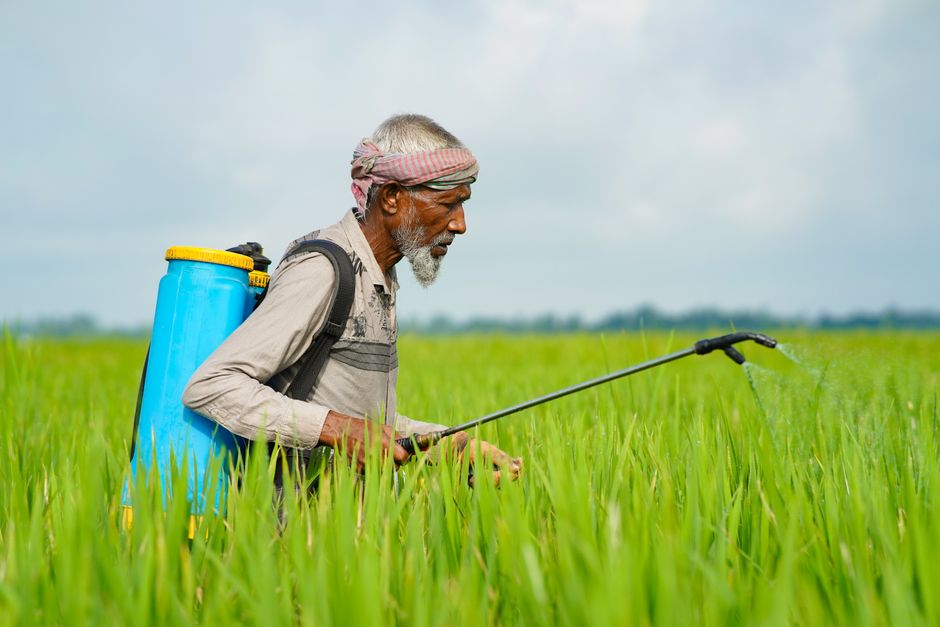
AgriVoice should tell a farmer to wait when it cannot verify that spraying so close to harvest is safe. A delayed answer can protect the farmer, the crop, and the people who may enter the farm or handle the cocoa.
At 6:40 on a Monday morning, Kwame stands at the edge of his cocoa farm with a sprayer beside his boot. He is an illustrative composite: an Asante-Twi-speaking farmer balancing an urgent crop problem against a harvest that cannot easily move.
The pods show signs that worry him. Harvest is close. If he waits, the damage may spread. If he sprays, the chemical may still require a longer pre-harvest interval than he has left.
He raises his phone and asks in Twi: “Can I spray this medicine today and harvest soon?”
The answer begins with what the system does not know
AgriVoice turns the voice message into text and looks for an answer among reviewed cocoa-advice blocks. It does not ask a language model to invent pesticide instructions.
The relevant block identifies a critical gap. The product name alone is insufficient. The approved content does not yet contain verified dosage, re-entry, and pre-harvest intervals for that chemical.
So the reply should sound more like this:
“Please wait. I cannot confirm that it is safe to spray now and harvest soon. Do not use the chemical based on this answer. Your question needs to go to the extension officer.”
That response may frustrate Kwame. He did not ask for a warning. He asked whether he could start spraying while the morning was still cool.
But “wait” is the useful answer because the system lacks the facts needed to say “yes.” A fluent guess could leave residue too close to harvest, expose someone who returns to the field too early, or cause the farmer to apply the wrong amount. The bad ending is still possible. Kwame may lose part of the crop while he waits, or spray without reliable guidance because the pressure feels immediate.
AgriVoice must not remove that tension with made-up certainty.
Why a confident answer would be more dangerous
Machine-generated agricultural language can sound complete even when a key safety detail is missing. That is especially risky in voice, where the answer arrives with the cadence of direct advice and may be acted on immediately.
Neuralis has already found how quietly language systems can distort domain terms: a translation test turned the Twi word for cocoa into “chicken.” That kind of mistake can be obvious in hindsight and invisible during a hurried exchange.
Chemical guidance creates a harder problem. A response might name a plausible product while omitting the amount to apply, the time before anyone re-enters the field, or the interval before harvest. Each omission changes what the farmer can safely do next.
AgriVoice therefore uses the language model for a narrow task: selecting reviewed content blocks. It does not let the model author agronomy. Pesticide answers retain required safety information, and incomplete or uncertain cases go to a person.
This choice follows a simple rule: uncertainty must remain visible when hiding it could cause harm.
The human handoff carries the answer forward
Kwame’s question cannot disappear into a generic support queue. Before the farmer pilot begins, a cocoa-sector partner must name the extension officer responsible for escalations. The operating target is a response in less than one working day at the median, with an accountable person watching the queue.
In the intended exchange, AgriVoice records the unresolved question and sends it for human review. The officer needs the details the automated answer could not safely supply: the exact product, the crop condition, how close harvest is, and the verified instructions governing its use.
Until that happens, Kwame has a clear boundary. He has not received permission to spray.
Late that morning, the sprayer is still resting where he left it. The disease concern remains, but one danger has changed: a missing safety interval has not been disguised as an answer.
The eventual human response could approve a specific action, recommend another treatment, or continue to withhold advice. AgriVoice cannot promise which. Its job in this moment is to keep an uncertain machine response from becoming a confident instruction.
Safety evidence comes before scale
This exchange is the standard the planned two-week pilot must test with 20 to 50 farmers. Neuralis is still preparing that pilot, and several entry gates remain: farming-aware Asante Twi translation, agronomist review of three held chemical blocks, real farmer-speech evaluation, and a tested escalation path.
The safety threshold is deliberately strict. No unreviewed or unsafe pesticide instruction should reach a farmer. Any such answer is a stop or redesign signal, even if the rest of the conversation feels fast and natural.
That discipline matters beyond agriculture. Voice systems often create pressure to answer every question because silence and refusal can feel like product failure. In a high-stakes exchange, refusal can be the feature doing the most work.
Before the pilot exposes a farmer to this flow, staff will rehearse the complete path: hear the question, select only reviewed content, preserve mandatory warnings, escalate uncertainty, and confirm that a named person receives it.
On Monday morning, Kwame wanted a quick “yes.” The safer system leaves the sprayer on the ground until someone qualified can earn that answer.
Comments
No comments yet.